TL;DR
Adaptability depends on more than recognizing and understanding change. Healthcare organizations also need clear ownership for the response, a disciplined way to incorporate AI into decision-making and a stronger connection between strategic priorities and everyday operations. These three capabilities help turn information into coordinated action and make improvement easier to sustain.
//
Healthcare organizations won’t lead the next decade simply because they can produce more information. They’ll lead because they can use that information to coordinate decisions and adapt as conditions change.
Part one of this series focused on four foundational capabilities: organizing analytics around decisions, identifying the changes that matter, treating business context as part of the data and learning from previous decisions. Those capabilities help an organization understand what’s happening and why.
Understanding, however, doesn’t guarantee action. A performance issue can be well documented and still remain unresolved when no one clearly owns the next step. AI can surface patterns without improving a decision if it isn’t connected to a defined workflow. A strategic priority can appear in an executive plan without shaping the operational decisions made every day.
The remaining three capabilities close those gaps. They help organizations translate information into ownership, connect technology to business decisions and keep strategy tied to day-to-day performance.
1. They’ll Make Accountability Easier to See
One of the most common breakdowns in performance management occurs after a problem has already been identified.
A team may agree that an issue requires attention but responsibility for the next step isn’t always clear. It may be uncertain who should investigate, who has the authority to decide whether intervention is necessary or when leadership should expect an update.
When accountability exists mainly in meetings, email threads and informal conversations, it can be difficult to maintain. People change roles. Priorities compete for attention. A decision made in one meeting may not be visible to the teams responsible for carrying it forward.
Leading organizations will connect ownership more directly to the decision process. When an important change occurs, teams should be able to see who’s responsible for evaluating it, what the next step is and when follow-up is expected. They should also be able to tell whether the issue is already being addressed.
This isn’t about adding another layer of administrative work. Clear ownership can reduce unnecessary coordination. People spend less time determining who’s responsible, duplicating analysis or repeatedly discussing the same issue. They can spend more time addressing the problem itself.
Visible accountability also strengthens the learning process. When the organization knows who made a decision, what action followed and how the result was evaluated, it can preserve a more complete record of what worked and why.
2. They’ll Use AI to Strengthen the Decision Process
Artificial intelligence will play a larger role in healthcare analytics. It can help organizations summarize complex information, identify patterns, detect anomalies and accelerate certain types of analysis.
Those capabilities can be valuable, but don’t eliminate the need for a strong decision process.
Organizations still need to determine which outcomes matter, what context should influence interpretation, when intervention is appropriate and who’s responsible for acting. Without that foundation, AI can create another stream of information competing for attention. It may identify more potential issues without helping teams decide which ones matter.
The organizations that gain the greatest value from AI will connect it to clearly defined business decisions and workflows. They won’t evaluate AI only by what it can generate or identify. They’ll also ask whether it helps the right person understand a change, make a decision or coordinate a response more efficiently.
For example, anomaly detection is more useful when the organization has already defined the measures that matter, the context needed to interpret a signal and the process for determining what should happen next. A summary is more useful when it supports a recurring decision than when it adds another disconnected output.
As AI capabilities become more widely available, access alone is unlikely to create a lasting advantage. The difference will come from how effectively organizations incorporate those capabilities into the way people work and decide.
3. They’ll Connect Strategy to Everyday Operations
Most healthcare organizations have clearly defined strategic priorities. They may focus on improving quality, managing costs, expanding access, strengthening value-based care performance or improving the patient experience.
The difficult part is translating those priorities into the thousands of operational decisions made across the organization.
When strategy and operations are disconnected, leadership may not recognize an emerging performance issue until it appears in a monthly or quarterly review. Operational teams may also struggle to see how their daily decisions contribute to broader organizational goals.
Leading organizations will create a stronger connection between strategic objectives and operational performance. Teams will understand how their work contributes to organizational priorities. Executives will have a clearer view of where performance is beginning to diverge from strategic expectations.
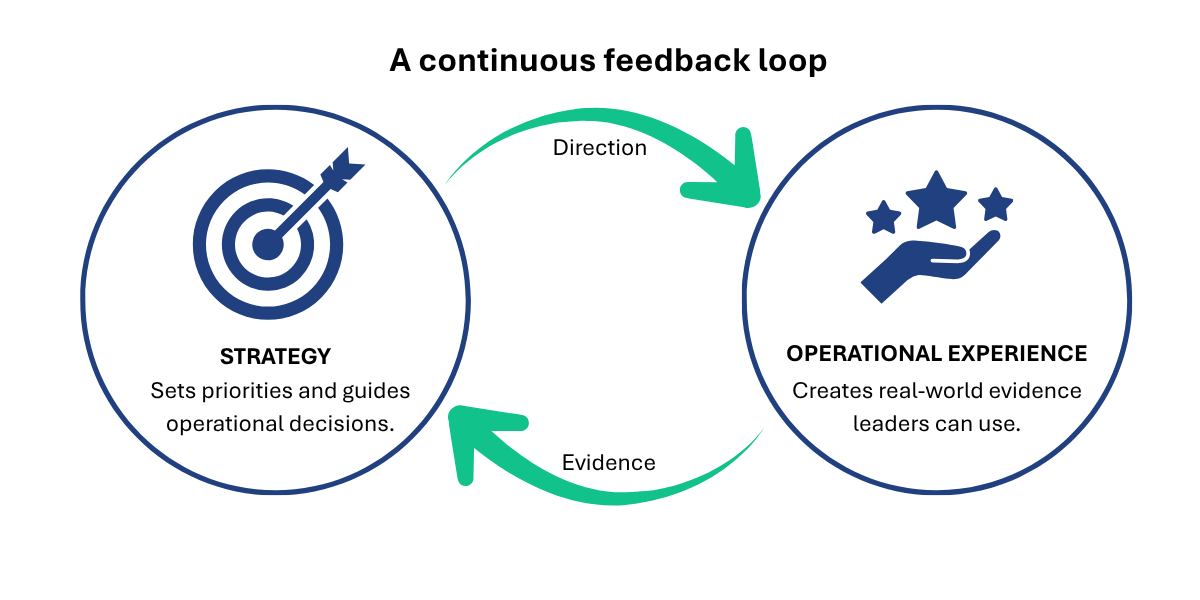
That connection needs to work in both directions. Strategy should help teams determine which outcomes deserve attention and which tradeoffs matter. Operational performance should give leadership timely information on whether the strategy is producing the intended result or needs adjustment.
This creates a continuous feedback loop. Strategy provides direction for operational decisions. Operational experience gives leaders evidence they can use to refine priorities, resource allocation and future decisions.
The Leading Organizations Will Be Purpose-Built for Continuous Adaptation
The next decade will bring changes healthcare organizations can’t fully predict. Technology will evolve. Business models and regulatory requirements will shift. New clinical, financial and operational challenges will emerge.
Organizations don’t need to anticipate every change to prepare for it. They need an operating environment that helps them recognize meaningful changes, understand what’s happening, decide how to respond and learn from the result.
That environment depends on all seven capabilities in this series. Trusted measures and decision-focused analytics help teams see what matters. Business context and organizational learning help them understand what produced a result. Visible accountability clarifies who should respond. AI strengthens the process when it’s connected to real decisions. A clear link between strategy and operations keeps everyday work focused on the outcomes that matter most.
At Salient Health, decision architecture serves this purpose. It provides the structure that helps healthcare organizations move beyond simply measuring performance and toward continuously managing and improving it.
Technology will remain an important part of that work, but technology alone won’t separate the leaders from everyone else. The advantage will come from how effectively an organization uses information to understand its business, coordinate decisions and respond to change.
Frequently Asked Questions
What will distinguish high-performing healthcare organizations over the next decade?
High-performing healthcare organizations will be distinguished by how effectively they use information to manage performance and adapt to change. They’ll recognize meaningful shifts, investigate what’s driving them, establish clear ownership for the response and evaluate whether their actions produced the intended result.
How can healthcare organizations make accountability clearer?
Organizations can connect ownership directly to the decision process. When an important change occurs, teams should be able to see who’s responsible for evaluating it, what action is expected, whether work is already underway and when follow-up should occur.
How will AI affect healthcare decision-making?
AI can help organizations identify patterns, summarize information, detect anomalies and accelerate analysis. It becomes more useful when it’s connected to defined outcomes, relevant business context, clear decision rights and an established process for responding.
How can healthcare organizations connect strategy to operations?
Organizations can connect strategic priorities to the measures, decisions and workflows used in daily operations. Teams need to understand how their work supports broader goals, while leaders need timely evidence showing where operational performance aligns with or diverges from strategic expectations.